
In the first post of this series, I addressed the fact that LonWorks is now a legacy technology and how its end-of-life (EOL) status impacts the long-term reliability and operations of passenger train fleets. Now, let’s look at considerations for moving forward with a technology replacement and some of the best options.
Ethernet: the clear choice for new train builds
With support for LonWorks chipsets now completely withdrawn by the manufacturer, what’s next? Existing LonWorks networks can continue to operate in your current passenger train vehicles. But dwindling or limited spare stock means there is a far greater urgency to choose a replacement technology for trains that still have years of service life. You also need to consider which network technology to choose for new trains.
The answer for new trains is fairly simple. As noted in my last post, new vehicle network designs in North America are dominated by Ethernet, and there are good reasons for this. Ethernet offers a high bandwidth that supports a far greater scope of rail applications and capabilities. There are variations, including the adoption of some past protocols (MVB, etc.) but generally, the Ethernet physical layer has been decided.
Beyond the physical layer, European and North American standards for Ethernet in passenger rail have also converged. This is leading to a unified standard for communication protocols and services within IEC 61375 – Train Communication Network (TCN).
A hybrid approach for existing fleets
For retrofitting existing passenger train fleets, some consideration needs to be made when dealing with aging technology like LonWorks, especially when the change is not a wholesale rewiring of the vehicle (which would be expensive). For instance:
- How many spares do you have?
- What is the failure rate of the LonWorks solution’s hardware/chipsets?
- Are you upgrading a single device on the network while still bridging to legacy LonWorks devices, or are you upgrading every piece of equipment?
These are important questions because they drive significant costs for re-engineering.
In some cases, and depending on funding, the optimal solution might be a partial replacement. Or it might be the addition of specialized networked devices, acting as a bridge to the legacy devices that are still supported and functioning well.
Legacy technology retrofits are surgical in nature
Replacing electronic equipment on an existing train with a legacy technology like LonWorks has two primary challenges:
- Replacing the physical network itself, including the wiring and the chipsets. Of course, you must also replace the protocol stacks and software interfaces.
- Ensuring that the new design meets the requirements at a networked system level with the interaction of all connected devices on the network. For something like LonWorks, this often involves some kind of segmenting of the physical network itself via a gateway device.
When moving forward with retrofit design and implementation, you should be considering the following questions:
- Which devices will be replaced (superseded) or updated?
- Will there be a legacy network and if so, how will it be maintained?
- Will new cybersecurity (or other) requirements be imposed on the updated design? Will they be imposed on the legacy design? How will this be handled?
- How much re-wiring is required? Is the new wiring located in a single cavity or do you need to run wire through the length of the vehicle?
- Are the new devices being installed co-located or dispersed throughout the vehicle?
- How many years of operation are needed from the updated network design?
Note that we have not opened this discussion to the vehicle interoperability level, which is another dimension that can add complexity to replacing and integrating legacy networks.
Figure 1 below shows the original LonWorks network and then a hybrid network where an existing LonWorks network is kept functioning while new devices are added to a new Ethernet network.
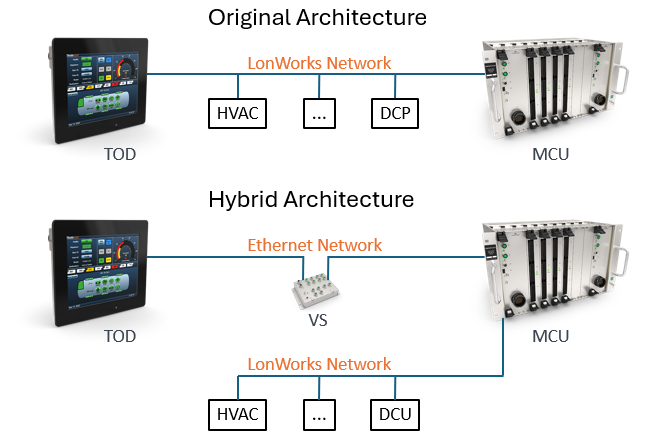
Figure 1: Examples of an original LonWorks network and a hybrid version showing Ethernet and LonWorks. HVAC = Heating, ventilation and air conditioning system, TOD = train operator display, MCU = monitoring & control unit, DCU = coor control unit, VS = vehicle switch.
Ethernet is a bridge to new operational benefits
Beyond on-train integration advantages, the evolution in services enabled by Ethernet in the consumer and industrial worlds has been flowing heavily into passenger rail over the last decade. Wired Ethernet, cellular networks, Wi-Fi and other more exotic forms of communication (like optical) are being specified regularly in new rolling stock procurements.
Trains are getting smarter, and new vehicles are now laden with the latest communication network technology, unlocking new levels of enterprise value. The expectations are massive, with benefits in many areas, including:
- State of good repair
- Safety and incident monitoring
- Passenger comfort
End-of-life challenges are not limited to LonWorks
LonWorks is only one example of the modern electronic world not meshing well with the long life cycles of train mechanical systems. Our next and final post in this series will expand on the topic of electronic component EOL for passenger trains. Choosing the right processes and partners can help transit authorities and operators more easily navigate these hurdles.
If your transit authority is currently planning for LonWorks replacement, Quester Tangent has the experience and technologies to help you through this transition. Contact us for a free consultation.